ETFE vs glass
The honest comparison.
ETFE is the most widely used glass alternative material for roofs and large-span enclosures. Here is where it beats glass, and where it doesn't.
Glass is the default for a reason. It is familiar, precise, and every specifier knows how it behaves. But overhead — on atria, concourses, stadium bowls and courtyards — it is being asked to do a job it was never especially good at: covering very large areas, in light, without weighing a great deal.
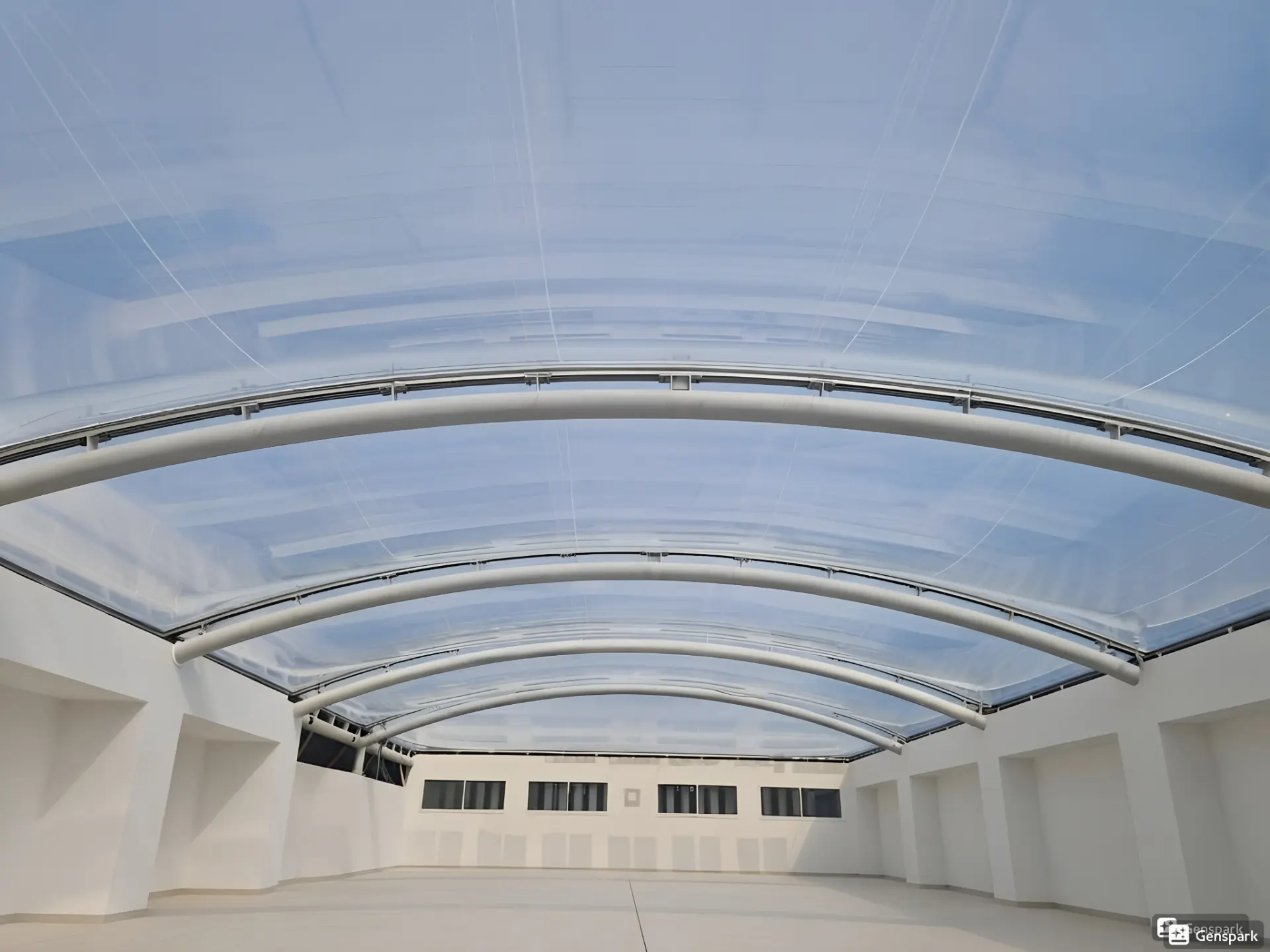
ETFE is a thin, tough, highly transparent fluoropolymer foil. Inflated into sealed cushions or tensioned as a single skin, it does that overhead job at a small fraction of the weight, and that weight difference is the whole argument.
Side by side.
| ETFE | Glass | |
|---|---|---|
| Weight | Around 5 kg/m² for a typical cushion system | Roughly 30–50 kg/m² once framing is counted |
| Clear span | Very large spans with slim supporting structure | Spans limited by pane size and framing weight |
| Daylight | Up to ~95% light transmission in single-layer foil | Typically far lower at roof level after coatings |
| Geometry | Curves, vaults and freeform shapes are routine | Curved and shaped glass is slow and costly |
| Impact | Deforms rather than shattering; nothing heavy falls | Breaks — a real hazard over occupied space |
| Maintenance | Self-cleaning surface, 75-year-plus foil life, components replaced without craneage or internal disruption | Access contracts and regular cleaning; reglazing needs plant and internal access |
| Acoustics | Acoustically live — lively, not quiet | Mass gives genuine sound separation |
| Security | Not a security barrier | Laminated and security glazing available |
Where glass still wins
Anywhere you need acoustic separation — offices, teaching spaces, concert halls, wards — glass has mass and ETFE does not. Anywhere you need a security barrier, or a perfectly flat optical view at eye level, glass is the right specification.
On most large buildings the answer is both: ETFE overhead where you want light and span, glass at the perimeter where people touch the building. What matters is deciding early — the structural grid is sized around the roof you choose, so switching after Stage 3 throws away most of the saving.
Seen in practice
Carlisle Station: where glass was taken out and ETFE put in.
An 1846 listed train shed whose glazed roof kept being broken by birds, dropping glass onto live platforms. Replacing it with ETFE designed the hazard out.
Read the case study →